No products in the cart.
Sale!

Original price was: $18.99.$9.12Current price is: $9.12.
3D Knife Throw – ShareWordpress.Net
200 in stock
Your WhatsApp integration probably fails at the webhook, not the pitch. Rate limits, stale contact records, and missed order updates quietly break the customer journey long before anyone notices the revenue leak. Fixing the plumbing matters more than adding another channel.
This article shows you how to map your CRM, ecommerce, and helpdesk touchpoints, then choose a platform based on API coverage, native connectors, and automation builders. You will learn to standardize field mapping and contact sync, automate handoffs without losing context, and track delivery and failure alerts so integrations keep working after launch.
Why Third-Party Integrations Break Down on WhatsApp Business API
Third-party integrations on the WhatsApp Business API fail for three primary reasons: webhook misconfigurations, rate limit breaches, and data sync gaps between systems. Each one can silently break a customer conversation before anyone notices.
The WhatsApp Business Platform enforces strict requirements around message delivery, endpoint verification, and throughput. Tools built for looser channels often assume they can send freely and receive events reliably. Those assumptions collapse quickly here.
Understanding these three pitfalls is the first step toward a resilient integration strategy. The sections below break down how each failure mode works and what to do about it.
Common Failure Points: Webhooks, Rate Limits, and Data Sync Gaps
Webhook failures often stem from incorrect endpoint URLs, missing verification tokens, or server timeouts that cause missed message events. A single dropped webhook can stall an entire conversation flow, since your CRM or help desk never learns that a customer replied.
Meta's webhook logs in the App Dashboard show delivery attempts, response codes, and payload summaries. Use them to confirm whether Meta reached your API endpoint and what your server returned. Common culprits include expired TLS certificates, slow responses beyond the timeout window, and handlers that fail on malformed payloads.
Rate limits follow a tiered model. A WhatsApp Business Account starts at a lower messaging limit and moves upward through tiers such as 1K, 10K, 100K, and unlimited unique recipients per 24 hours. Tier upgrades depend on volume and quality rating, so growth is earned rather than granted.
Exceeding a limit returns error code 131056, which signals that the recipient pair or account has hit a throughput ceiling. Sending bursts of template messages during a campaign is a frequent trigger. Spread sends over time and monitor quality signals to avoid throttling.
Data sync gaps appear when contact updates or order statuses fail to propagate between systems. A customer changes their phone number in your CRM, but the WhatsApp Business Account still holds the old record. The result is duplicate messages, lost context, or replies routed to the wrong agent.
- Implement retry logic with exponential backoff for failed webhook deliveries and API calls
- Use idempotency keys so repeated requests do not create duplicate messages
- Log every inbound and outbound event with timestamps for reconciliation
- Reconcile contact records on a schedule, not just when changes occur
These practices turn fragile point-to-point connections into integrations that recover on their own. Retries handle transient failures, while idempotency and logging prevent the silent corruption that erodes trust in the channel.
Map Your Integration Stack Before You Optimize
Before optimizing any integration, you must document every system that touches your WhatsApp Business API workflow. A clear map reveals redundancies, bottlenecks, and missing links that are invisible when you look at each tool in isolation.
Optimization without a map is like navigating without a compass. You may make changes, but you cannot tell whether they help or simply shift the problem somewhere else.
Start by listing every platform connected to your WhatsApp Business Account: your CRM, ecommerce store, helpdesk, marketing tools, and any internal databases. Note which systems send data, which receive it, and which do both.
This map becomes the foundation for the audit that follows. It shows where customer records, order events, and conversation histories actually travel, so you can focus on the touchpoints that matter most.
Auditing CRM, Ecommerce, and Helpdesk Touchpoints
Start your audit by listing every point where customer data enters or exits your WhatsApp Business API integration. Typical sources include a CRM such as Salesforce or HubSpot, an ecommerce platform such as Shopify or WooCommerce, and a helpdesk such as Zendesk or Freshdesk.
For each system, document the data flow in plain terms. What event triggers a sync? Which fields are exchanged? How are failures handled, and who gets notified?
- Identify all systems connected to your messaging workflow, including secondary tools that share data with your primary platforms.
- Document each data flow: the trigger, the fields exchanged, the direction of travel, and the error handling path.
- Map every touchpoint in a spreadsheet, noting sync frequency and how critical each one is to customer experience.
- Flag common gaps, such as CRM contact updates that never reach WhatsApp, or order status changes that fail to trigger a message.
Use this checklist of questions for each system:
- Which fields sync, and which are ignored?
- How often does the sync run, and is that frequency sufficient?
- What happens when a sync fails, and is anyone alerted?
- Does the system rely on webhooks, scheduled jobs, or manual exports?
- Are access tokens and permissions current, including OAuth 2.0 credentials and permanent tokens tied to a system user?
- Does the integration respect API rate limits and throughput constraints?
Pay attention to how message types interact with your stack. A template approval delay can stall a notification flow, while session messages, interactive messages, and media messages may each depend on different data fields. If your ecommerce platform cannot pass an order ID into a button message or quick reply, the customer experience breaks at a predictable point.
Record the criticality of each touchpoint as high, medium, or low. High-criticality flows, such as authentication messages or delivery updates, deserve tighter monitoring and faster error handling than a weekly marketing sync.
Finally, check your phone number ID, WABA, and business portfolio configuration against what each connected system expects. Mismatches here often explain sync failures that look like application bugs but are really configuration drift.
Choose a Platform Built for Integration Depth
Not all WhatsApp Business API platforms are created equal. Some are built for basic messaging, while others offer deep integration capabilities.
The distinction matters because a shallow platform forces your team to build every connection from scratch. A platform designed for integration depth reduces custom development and provides the tools needed to connect your existing systems with less friction.
When a platform exposes a wide range of API endpoints, supports webhooks, and offers pre-built connectors, your engineering effort shifts from plumbing to product. That is the difference between a messaging tool and an integration hub.
The criteria below help you separate platforms that merely send messages from those that can genuinely support complex, multi-system workflows. Use them to evaluate any WhatsApp Business API provider before committing.
What to Evaluate: API Coverage, Native Connectors, and Automation Builders
When evaluating a platform, prioritize three areas: breadth of API coverage, availability of native connectors, and the power of its automation builder. Each area determines how much custom code your team must write and maintain.
API coverage means checking whether the platform exposes endpoints for every action you need. Sending session messages, submitting message templates for approval, retrieving analytics, and managing media messages should all be accessible programmatically. Look for support for webhooks so your systems receive real-time events, and confirm the platform handles authentication cleanly through OAuth 2.0, access tokens, and permanent tokens tied to a system user.
Native connectors are pre-built integrations with popular CRMs, ecommerce platforms, and helpdesks. These save months of development because the connection logic, field mapping, and error handling already exist. Verify that connectors cover your actual stack, not just the most common tools.
Automation builders let you create complex workflows without coding. A visual drag-and-drop interface should support conditional logic, branching, and triggers based on incoming webhook events.
- API coverage: endpoints for sending messages, managing templates, retrieving analytics, and handling media
- Authentication: OAuth 2.0 support, permanent token generation, and system user management
- Connectors: pre-built links to your CRM, ecommerce platform, and helpdesk tools
- Automation: visual builder with conditional logic, branching, and webhook triggers
- Events: webhook support for delivery status, inbound messages, and template approval changes
Evaluate each area against your actual integration requirements. A platform that scores well on all three reduces the gap between your WhatsApp channel and the rest of your business systems.
Standardize Data Flow Between Systems
Standardizing data flow ensures that every system speaks the same language, preventing mismatched fields and lost information. Inconsistent data formats are a leading cause of integration failures, especially when a WhatsApp Business API platform exchanges records with CRMs, help desks, or order management tools.
A canonical data model solves this by defining one agreed structure for each entity, such as contacts, orders, and messages. Every connected system then maps its own fields to that shared model instead of mapping directly to each other.
Clear mapping rules matter just as much. Document how each source field converts into the canonical format, including formats, required values, and fallback behavior for missing data.
Once those rules exist, integration work shifts from one-off fixes to repeatable configuration. The next section covers the specific techniques that make this practical.
Field Mapping, Contact Sync, and Order Update Triggers
Field mapping is the process of aligning data fields from one system to another, for example, mapping a CRM's "phone" field to WhatsApp's "wa_id". Getting this right is the foundation of every reliable third-party integration built on the WhatsApp Business API.
A structured approach keeps mapping work manageable as systems grow. Follow these steps in order:
- Create a master field list. Collect every field used across your CRM, ecommerce platform, support desk, and WhatsApp Business Account (WABA). Note the field name, data type, and which system owns it.
- Define transformation rules. Specify how values convert between systems, such as date formats (ISO 8601 is a safe default), phone number normalization to E.164, and text casing rules.
- Implement contact sync. Choose bidirectional updates for real-time accuracy or scheduled batch jobs for high-volume, lower-urgency data.
- Set up order update triggers. Fire events on specific actions like order shipped or payment received, then send the relevant WhatsApp message template through the API endpoint.
Webhooks carry incoming events from Meta to your system. A simple handler receives the payload, maps fields to your CRM schema, and writes the record. Pseudocode for that flow looks like this:
on webhook received: verify signature with access token parse payload (contact, message, status) map wa_id to CRM phone field normalize timestamp to ISO 8601 upsert contact record if event == "order_shipped": send approved template message return 200 OK
Always verify the webhook signature and respond quickly to avoid retries. A permanent token tied to a system user keeps authentication stable, while OAuth 2.0 flows suit multi-tenant setups.
Automation tools like Zapier or native platform connectors can handle simple field mapping and sync without custom code. For complex transformation logic or high throughput, a direct webhook handler gives more control over API rate limits and message template approval rules.
Whatever path you choose, log every mapping failure. Repeated errors usually point to a missing transformation rule rather than a broken connection.
Automate Handoffs Without Losing Context
Automating handoffs between bots and human agents is critical to maintaining a seamless customer experience. When context disappears at that moment, customers repeat themselves and agents waste time reconstructing a conversation that already happened.
The real challenge is passing conversation history and customer data from the bot to a CRM or ticketing system. Without a shared record, the agent sees a stranger instead of a known contact with an open issue.
Solving this means treating every handoff as a structured data event, not just a transfer of the chat. The techniques below show how to wire that event across your third-party integrations.
Connecting Bot Flows to CRM and Ticketing Tools
To connect bot flows to CRM and ticketing tools, use webhooks to pass structured data at key points in the conversation. A webhook is simply an API endpoint your bot calls when something important happens, such as an escalation request.
Design the flow so the handoff fires at the moment of escalation. The bot should call a webhook that creates a ticket in the helpdesk system, carrying the customer ID, the full conversation transcript, and a short issue summary.
Concurrently, the CRM record should be updated with the latest interaction. This keeps sales, support, and account history aligned instead of scattered across separate tools.
When the agent replies, that message should be sent through the WhatsApp Business API and logged back in the CRM. The customer stays in one channel while your teams work in the tools they already use.
Consider a support flow built on Zendesk or Salesforce. The bot detects a billing dispute, calls a webhook, and opens a ticket with the transcript attached. The agent answers from the helpdesk, and the reply travels back through the API to the customer.
One detail makes all of this reliable: include a unique conversation ID in every payload. That single identifier links the WhatsApp thread, the ticket, and the CRM record, so no update lands in the wrong place.
- Pass the customer ID and phone number ID with each webhook call.
- Attach the transcript and an issue summary to the new ticket.
- Log the agent's reply back into the CRM after it sends.
- Reuse the conversation ID across every system that touches the case.
With this structure in place, the next step is refining how each integration handles authentication, retries, and message templates so handoffs stay dependable at scale.
Monitor, Test, and Iterate on Integration Performance
Continuous monitoring and testing are essential to catch integration issues before they impact customers. A third-party integration that works perfectly on launch day can quietly degrade weeks later as APIs change, traffic grows, or Meta updates platform behavior.
Treat every connection between your WhatsApp Business API platform and an external system as a living component that needs regular attention. That means watching key performance signals, running scheduled tests, and acting on what the data reveals.
Teams that skip this step often discover problems only when customers complain about missing messages or slow replies. A structured monitoring routine turns those surprises into fixable alerts.
The subsections below cover the specific metrics worth tracking and the testing practices that keep third-party integrations reliable over time.
Tracking Delivery, Response Times, and Failure Alerts
Track message delivery rates, API response times, and webhook failure rates to identify integration bottlenecks. Each metric points to a different layer of the integration stack, so monitor them together rather than in isolation.
Delivery rates show the percentage of messages successfully delivered versus failed. Use WhatsApp's status webhooks to capture sent, delivered, read, and failed events for every outbound message template or session message. A sudden drop often signals a template approval issue, a quality rating problem, or a bad phone number ID.
Response times measure how long it takes a third-party API to answer a request. Set clear thresholds, such as under 500ms for internal calls, and log every breach. Slow responses compound across retries and can push you toward API rate limits.
Failure alerts deserve their own pipeline. Log and alert on webhook failures, HTTP 429 rate limit errors, and authentication problems like expired access tokens or broken OAuth 2.0 flows.
- Use Prometheus and Grafana, or a custom dashboard, to visualize trends over time.
- Route critical alerts to on-call channels so failures never sit unnoticed.
- Track permanent token and system user credentials before they expire.
Pair monitoring with a testing regimen. Run regular load tests to check throughput against your current messaging limit tier. Apply chaos engineering to see how the integration behaves when a dependency fails. Use canary deployments to roll out changes to a small slice of traffic first.
Review the data regularly and iterate. If response times creep up after a provider update, adjust retry logic or caching. If delivery rates dip, audit template approval status and quality rating. Small, data-driven adjustments keep the integration healthy and reduce the risk of tier downgrades.
Where Com.bot Fits Into an Integration Strategy
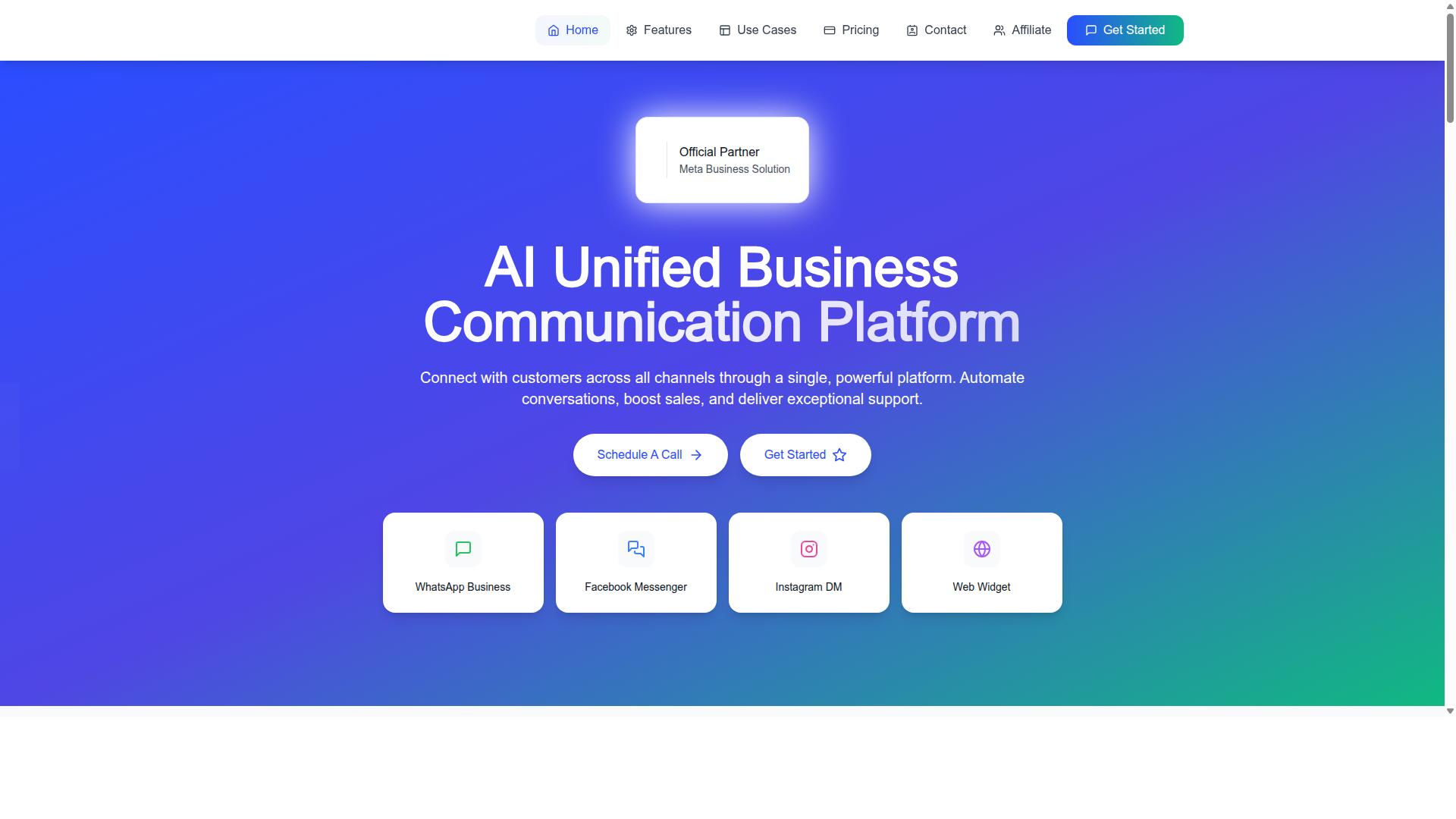
Com.bot is an AI Unified Business Communication Platform that connects customers across WhatsApp, Facebook Messenger, Instagram DM, and Web Widget through a single platform. It is an Official Meta Business Partner with direct WhatsApp Business API integration, which means the underlying connection to Meta's messaging infrastructure is handled for you.
That matters because most integration problems in a WhatsApp Business API setup come from the plumbing: managing access tokens, keeping webhook endpoints reliable, and syncing conversation data with the rest of your stack. Com.bot removes that overhead by acting as the layer between WhatsApp and the tools your team already uses.
Rather than treating messaging as an isolated channel, it plugs conversations into your CRM, helpdesk, and ecommerce systems so data flows both ways. The next section breaks down the specific capabilities that make this possible.
Unified Inbox, 1000+ Automation Integrations, and Multi-Channel Support
Com.bot offers a unified team inbox that consolidates conversations from WhatsApp, Facebook Messenger, Instagram, and web widget into one interface. Role-based access keeps the right people on the right conversations.
The automation layer is where third-party integration gets practical. Com.bot ships with an Automation Builder featuring 1000+ integrations, connecting CRMs, ecommerce platforms, and helpdesks through native connectors and webhooks. A visual bot builder with a drag-and-drop interface lets teams create automation flows without writing code.
Multi-channel support means customers can engage on their preferred channel while your team works from a single system. Com.bot also supports native payments for WhatsApp transactions, so payment collection can happen inside the conversation. Bulk messaging and order updates round out the outbound side.
For scale and credibility, Com.bot serves 23,000+ active customers and processes 25M+ messages per day. It is owned and managed by Com Bot AI Limited. Teams that want to evaluate the platform can learn more or start a free trial to see how the connectors map to their existing stack.
Get Started with Com.bot Today
Ready to streamline your WhatsApp Business API integrations? Contact Com.bot today to see how we can help. Whether you are refining your webhook handling, tightening template approval workflows, or improving throughput across your API endpoints, a short conversation can clarify where the biggest gains sit.
Com.bot works with businesses that rely on the WhatsApp Business Platform to connect messaging to their wider software stack. If your team manages a WhatsApp Business Account (WABA) and wants third-party integrations to behave more predictably, reaching out for a consultation is a practical first step.
You can share your current setup, including how you handle session messages, interactive messages, and media messages, and get a clearer view of what to prioritise. The team keeps the discussion grounded in your actual integration goals rather than a generic sales pitch.
Here are the ways to get in touch:
- Head Office: 501, Trinity Orion, Vesu Main Road, Surat - 395010, IN
- Phone/WhatsApp: +91 080 6987 1810
- Email: [email protected]
- Business Hours: Monday - Friday: 9:00 AM - 6:00 PM IST
- WhatsApp Support: available for quick questions
If you prefer a written record of how Com.bot handles data, billing, or service expectations, note that policies are available on request. That is useful when your legal or compliance team needs to review terms before you connect a production WhatsApp Business API integration.
Com.bot also offers an affiliate program for partners and agencies that want to introduce clients to the platform. If you work with multiple businesses running their own WABA setups, this can be a straightforward way to extend the relationship.
For teams comparing an on-premises API against the Cloud API, or weighing a Business Solution Provider (BSP) arrangement, a consultation is a good place to talk through trade-offs. Bring your questions about access tokens, permanent tokens, system users, phone number IDs, and messaging limits, and leave with a clearer plan for your next integration improvement.
Recommended Resources:
Reviews
There are no reviews yet.
Related products
Sale!
WordPress Plugins
Appointment Booking WordPress Plugin – WP Timetics – ShareWordPress.Net
Original price was: $15.99.$7.68Current price is: $7.68.
Sale!
WordPress Plugins
Original price was: $5.50.$2.64Current price is: $2.64.
Sale!
WordPress Plugins
Twilio SMS Bulk Sender – ShareWordPress.Net
Original price was: $3.99.$1.92Current price is: $1.92.
Sale!
WordPress Plugins
Alukas – Multipurpose Shopify Theme OS 2.0 – ShareWordPress.Net
Original price was: $6.99.$3.36Current price is: $3.36.
Be the first to review “3D Knife Throw – ShareWordPress.Net”